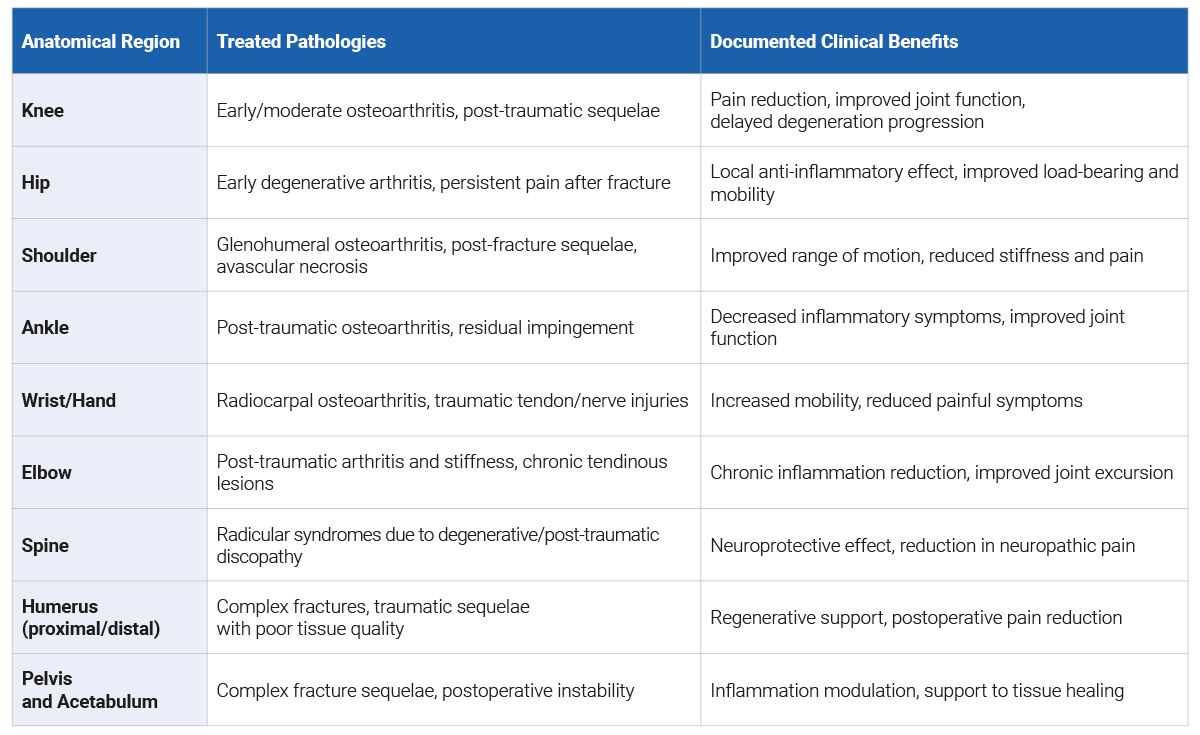
Advanced osteoarthritis of the knee, hip, shoulder, and ankle (pre- or post-arthroplasty): → reduction of periarticular inflammation and improved pain control.
Major joint replacement procedures (knee, hip, shoulder): → biological support for biomaterial integration and reduction of local inflammatory response.
Complex fractures at high risk of delayed union or nonunion: → stimulation of tissue regeneration and support for healing processes.
Post-traumatic joint or periarticular tissue damage: → modulation of chronic inflammation and promotion of soft tissue repair.
Revision arthroplasty surgery: → enhancement of the tissue microenvironment and potential support for osseointegration.
Role of mesenchymal Stem Cells (ADSCS) inOrthopedicsandTraumatology
Cartilage: → Regenerative support in peri-prosthetic osteoarthritis and traumatic lesions.
Tendons and ligaments: → Regeneration in chronic tendinopathies and periarticular injuries.
Muscle: → Repair of traumatic injuries and post-surgical atrophy.
Periarticular soft tissues: → Inflammation reduction and enhanced regeneration.
Clinical effects
Anti-inflammatory Effect: → Mesenchymal stem cells (ADSCs) modulate the inflammatory response by secreting anti-inflammatory cytokines (IL-10, TGF-β). They reduce pain and swelling in periarticular and periprosthetic tissues, improving load tolerance in joints affected by osteoarthritis or traumatic processes. They also promote macrophage transition from the pro-inflammatory (M1) to the regenerative (M2) phenotype, contributing to inflammation resolution.
Regenerative Effect: → Mesenchymal stromal cells stimulate proliferation and differentiation of resident cells in bone, cartilage, and tendon tissues damaged by trauma or degeneration. They promote angiogenesis and remodeling of the extracellular matrix, improving the structural and functional quality of tissues surrounding prosthetic or injured areas.
Analgesic Effect: → The combined anti-inflammatory and regenerative action leads to significant pain reduction, even in chronic conditions related to osteoarthritis or post-surgical trauma. This results in a reduced need for anti-inflammatory drugs or corticosteroid injections.
Immunomodulatory Effect: → ADSCs modulate immune cell activity (lymphocytes, macrophages, dendritic cells), attenuating inflammatory and autoimmune responses, useful in degenerative joint diseases or inflammatory reactions associated with prosthetic and traumatic surgery.
Functional Improvement: → The use of mesenchymal cells is associated with increased joint range of motion, improved muscle strength and overall limb functionality, and reduced post-operative or post-trauma recovery times.
ClinicalApplicationsof IntraGraft® Fat in Orthopedics & Traumatology