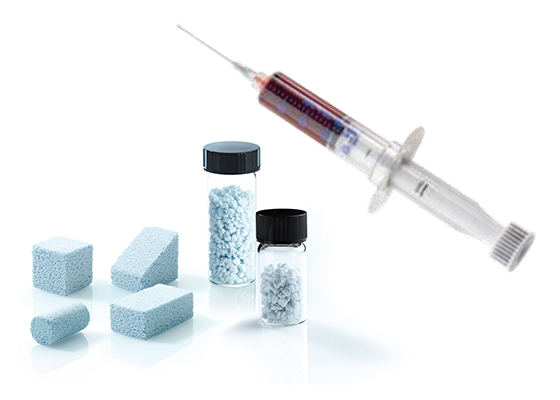
USE OF BONEMARROWASPIRATECONCENTRATE WITH HIGH MESENCHYMAL STROMAL CELL CONTENT (BMAC)
Autologous bone marrow concentrate obtained through selective aspiration from hematopoietic bone marrow represents a biologically active source of mesenchymal stromal cells (MSCs), applicable in orthopedic, sports, and trauma-related regenerative medicine.
Depending on its combination with osteoconductive biomaterials or bone grafts, BMAC isused in a wide range of clinical indications.
Direct Use of BMAC (withoutcombinationwithothermaterials)
Clinical Indications:
• Bone cysts (unicameral, aneurysmal): injection to stimulate endogenous osteogenesis and promote resolution of the cysticcavity • Degenerative joint diseases (intra-articularinjections): usedto modulate inflammation and improve the joint microenvironment • Chronic tendinopathies (Achilles, patellar, epicondylitis): applied to stimulate tendon regeneration via paracrine factor release • Degeneration of vertebral facet joints (low back pain): periarticular injection for trophic and analgesic effects
BMAC combined with bone substitutes (syntheticorxenogenicbiomaterials)
Clinical Indications:
• Spinalarthrodesis: combined use to promote bone fusion by increasing the osteogenic cellular component • Subchondral lesions (e.g., bone edema, osteochondritis): used for trabecular regeneration and stabilization of the subchondral segment • Peripheral joint arthrodesis (e.g., tibio-tarsal, interphalangeal): improved biological integration and reduced consolidation time
BMAC combined with autologous bone
Clinical Indications:
• Osteonecrosis(femoral head, early stages): combined with core decompression to delay collapse progression. • Post-traumatic or degenerative subchondral lesions: stimulation of bone remodeling via enhanced osteogenic grafting. • Non union and delayed union: integration at non union sites to enhance regenerative potential. • Complexor high-energy fractures: biological support in patients with high risk of delayed healing